Partial Timing Support - Unicast PTP in StarlingX
Learn about the new Partial Timing Support (PTS) feature in StarlingX, enabling unicast PTP synchronization over Layer 3 networks.
The StarlingX community continues to expand the platform's precision timing capabilities. Following the introduction of multi-instance PTP configurations, redundant timing sources, and O-RAN PTP notifications, the StarlingX 12.0 release introduces Partial Timing Support (PTS) to enable unicast PTP time distribution over Layer 3 IP networks.
What is Partial Timing Support?
In the earlier StarlingX PTP blog posts, we explored configurations based on the ITU-T G.8275.1 telecom profile. G.8275.1 uses Layer 2 multicast PTP, meaning that every node in the timing path must directly participate in PTP and be connected at the Ethernet layer. This is referred to as Full Timing Support (FTS) because the entire network is timing-aware.
However, not all network deployments have this luxury. In many real-world scenarios, PTP nodes need to synchronize across Layer 3 boundaries via routers, across VLANs, or over wide area networks where intermediate nodes do not participate in timing. This is where Partial Timing Support comes in.
PTS corresponds to the ITU-T G.8275.2 telecom profile. Instead of relying on L2 multicast, G.8275.2 uses unicast PTP messages transported over IPv4 or IPv6. A PTP node configured for PTS establishes direct unicast sessions with specific grandmaster clocks, requesting timing information through unicast negotiation. This allows timing distribution across networks where not all intermediate nodes are PTP-aware.
Why Does PTS Matter?
PTS addresses several important deployment scenarios:
- Geographically distributed sites: Edge nodes at remote locations can synchronize with a centralized grandmaster over an IP network without requiring PTP-aware switches along the path
- Mixed network environments: In networks where only certain segments support PTP, PTS allows timing to traverse non-PTP segments via standard IP routing
- Flexible transport options: PTS supports both IPv4 and IPv6, making it adaptable to a wide range of network architectures
- Hybrid topologies: A single StarlingX node can receive time via unicast PTS on one interface while distributing time via L2 multicast (G.8275.1) on another, bridging the two timing domains
PTS Deployments in StarlingX
StarlingX supports two primary PTS deployment models: Telecom Boundary Clock (T-BC) and Telecom Grandmaster (T-GM).
T-BC PTS Deployment
In this configuration, a StarlingX node acts as a boundary clock that receives time from a remote grandmaster over unicast IPv6 (G.8275.2) and distributes it to local downstream nodes over L2 (G.8275.1).
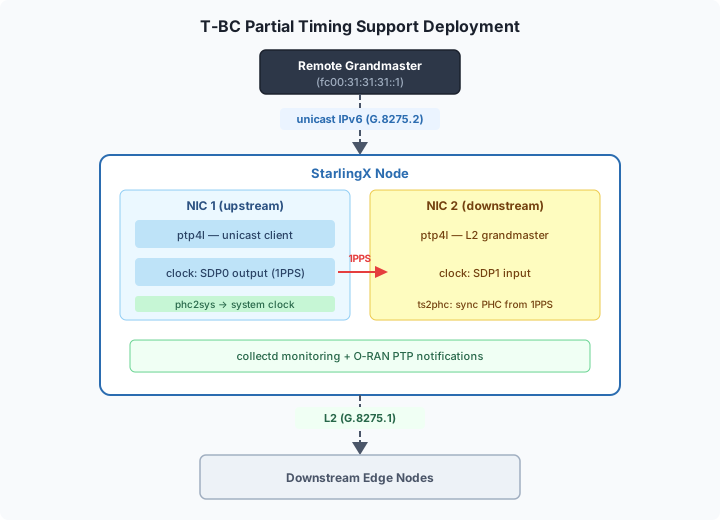
The upstream NIC receives timing from the remote grandmaster via unicast and passes a 1PPS signal to the downstream NIC, which then distributes time to local nodes using the traditional L2 multicast profile. This hybrid approach is particularly useful for edge sites that need to synchronize with a central timing source but distribute time locally using G.8275.1.
T-GM PTS Deployment
In this configuration, a StarlingX node with a local GNSS receiver acts as a grandmaster, serving time to remote clients over unicast IPv6.
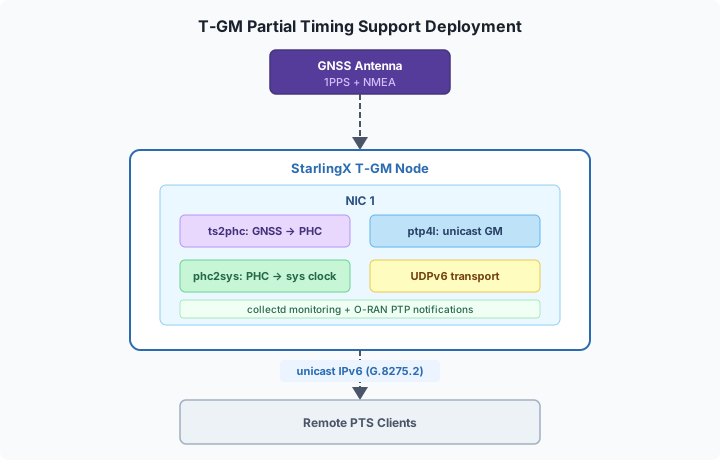
In this topology, the node derives its timing from a connected GNSS antenna and advertises time over unicast to remote clients. The remote clients configure their own unicast master tables pointing to this node's address. This enables a centralized grandmaster to serve accurate time to geographically distributed nodes without requiring PTP support on the intermediate network infrastructure.
Key Configuration Concepts
Unicast Master Tables
The central concept in PTS configuration is the unicast master table. A unicast master table defines the set of upstream grandmaster addresses that a PTP client node will contact to request time. Each table specifies:
- A unique table ID
- The query interval for unicast grant requests
- One or more grandmaster addresses (IPv4 or IPv6)
Multiple grandmaster entries within a single table provide redundancy — if one grandmaster becomes unreachable, the node can acquire time from another.
G.8275.2 Profile Parameters
PTS deployments use a distinct set of PTP profile parameters compared to G.8275.1. The most notable differences include:
- Domain 44: The G.8275.2 profile typically uses PTP domain 44, compared to domain 24 used by G.8275.1
- UDP transport: The network transport is set to UDPv4 or UDPv6 instead of L2
- Dataset comparison: Uses G.8275.x dataset comparison for clock selection
- Unicast negotiation: Client ports use
inhibit_announceto suppress multicast announce messages, and master ports useunicast_listento accept incoming unicast requests
Mixed-Transport Interfaces
One of the strengths of StarlingX's PTS implementation is the ability to configure mixed transport modes within a single ptp4l instance. An upstream interface can operate over unicast IPv6 while a downstream interface operates over L2 within the same instance. This simplifies the deployment of boundary clocks that bridge PTS and FTS network segments.
Integration with Existing PTP Features
PTS builds on the multi-instance PTP framework that has been available since StarlingX 7.0. It integrates with:
- phc2sys: System clock synchronization works the same way, reading from the ptp4l-disciplined PHC
- ts2phc: For T-GM deployments, ts2phc provides the GNSS-to-PHC synchronization that feeds the unicast grandmaster
- Clock instances: NIC-level pin configuration (SDP pins, 1PPS routing) is used to relay timing between NICs in multi-NIC topologies
- PTP monitoring: The existing collectd-based monitoring and O-RAN notification framework continues to report timing state for PTS instances
Getting Started
If you're interested in deploying PTS in your StarlingX environment, the official documentation provides step-by-step configuration procedures for both T-BC and T-GM deployments, including complete CLI examples and generated configuration file references.
Prerequisites for a PTS deployment include:
- Layer 3 IP connectivity between your node and the remote grandmaster
- UDP ports 319 and 320 open for PTP event and general messages
- A NIC that supports hardware timestamping
- At least one configured ptp4l instance using UDP transport
Looking Ahead
Partial Timing Support is a significant addition to StarlingX's timing portfolio. By enabling unicast PTP over IP networks, it opens up deployment scenarios that were previously only achievable with dedicated timing appliances or fully PTP-aware network infrastructure. Whether you're connecting remote edge sites to a central timing source or distributing time across a routed network, PTS provides the flexibility to deploy precise timing where it's needed.
The StarlingX community continues to advance the platform's timing capabilities. Stay tuned for future enhancements to PTP support, including improvements to servo tuning for PTS networks and expanded monitoring capabilities.
If you would like to learn more about the project and get involved check the website for more information or download the code and start to experiment with the platform.